




Online Poker vs Live Poker: Which One Makes You a Better Player?

Every serious poker player eventually confronts this question, usually framed as a rivalry: online grinders dismissing live poker as slow, live players dismissing online as soulless button-clicking. Both caricatures miss the point. The two formats are different training environments that build different muscles, and understanding exactly what each develops, and what each neglects, tells you how to use them.
This article compares live poker vs online poker across the dimensions that matter for your development: volume, information, discipline, game quality, and the harder-to-measure qualities that separate complete players from technicians. The honest conclusion up front: both make you better, but they make you better at different things, and one of them cannot be substituted.
The Case for Online: Volume and Precision
Online poker’s great gift is repetition. A live table deals roughly 25 to 30 hands per hour; a single online table deals 60 to 80, and multi-tabling players see several hundred. A dedicated online player can compress a year of live experience into a month of screen time.
Volume accelerates one specific kind of learning: pattern recognition across situations. Pre-flop discipline, standard c-bet spots, pot-odds arithmetic: these become automatic through sheer repetition faster online than anywhere else. Online play also generates data. Hand histories and tracking software let you audit your decisions with a rigour that live poker can’t match, finding leaks in your game with statistical evidence rather than memory.
If your goal is technical fluency, the mechanical correctness of decisions, online reps are the fastest route to it. That much the online camp gets right.
The Case for Live: Information and Depth
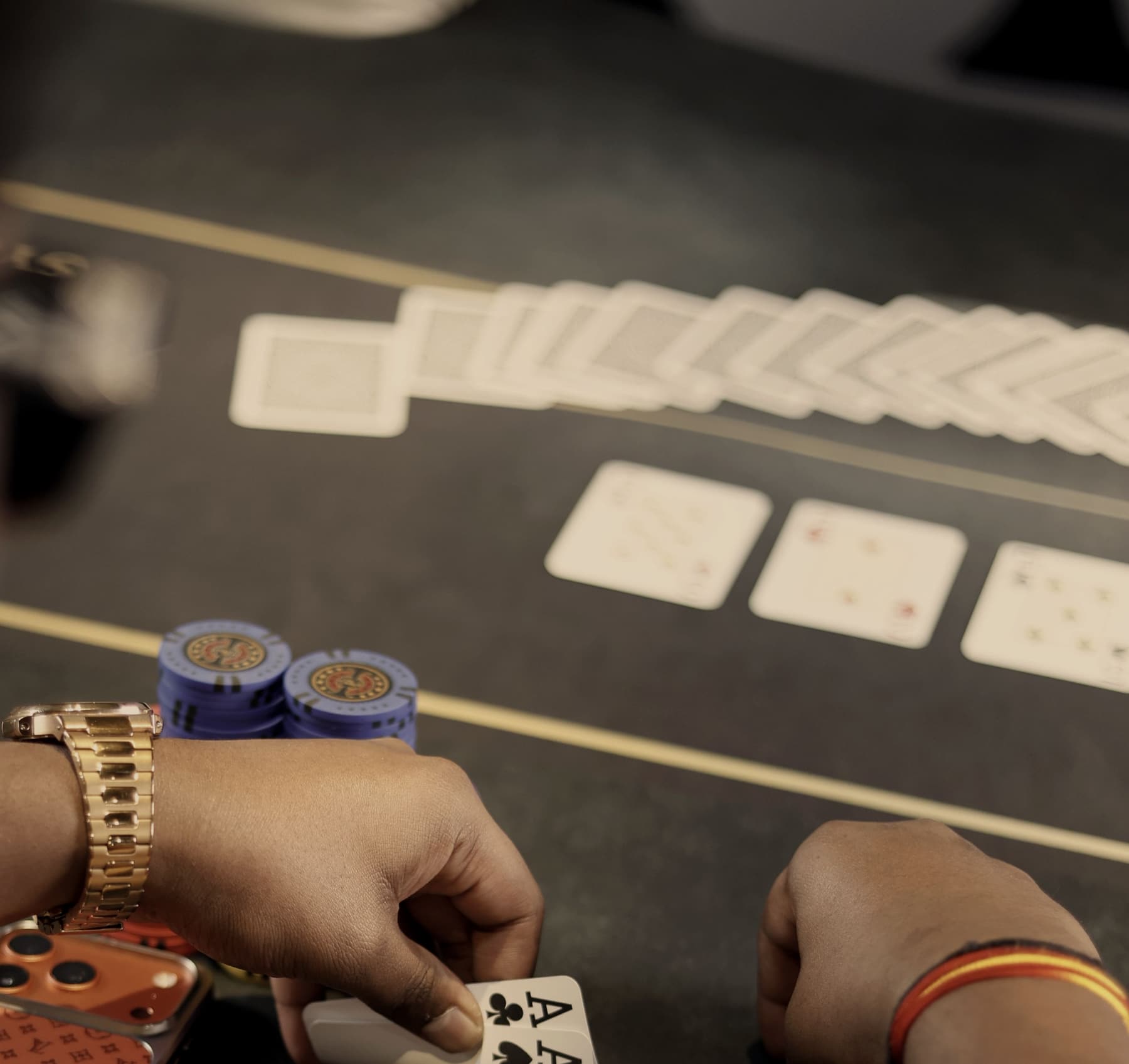
Now for what the screen cannot give you. A live poker table is drenched in information that online play simply deletes: posture, timing, chip handling, table talk, the physical story every opponent tells across a session. Learning to collect and weigh that information, the craft we cover in our guide to reading poker tells, is a genuine skill layer that online players never develop, and it shows when they sit down at a live table.
Live poker also changes the texture of decisions. With one hand every two minutes instead of five tables blinking for attention, you have time to think properly: to reconstruct the hand, consider your opponent’s range, and notice what their hands are doing while they wait. Depth replaces breadth. Many players find their most significant strategic growth happens live, precisely because each decision receives full attention rather than a split second of it.
And there’s the matter of pressure. Losing a stack of real chips that you physically slide across the felt lands differently from watching a number change on a screen. Live poker trains emotional regulation under authentic stakes, and that training transfers; screen poker’s abstraction, many players discover, had been quietly subsidising their composure.
Game Softness: Where Winning Is Easier
Here’s the practical point the formats’ partisans agree on: live games are typically softer. The reasons are structural. Online poker’s convenience concentrated studied, tool-assisted regulars; a low-stakes online game today is often a table of decent players politely exchanging small edges. Live poker draws a broader population: social players, occasional visitors, people there primarily for the experience. Comparable stakes play very differently as a result, and most professionals will tell you a live game plays several levels softer than the same blinds online.
For a developing player this matters twice over. Softer games mean your disciplined fundamentals get paid sooner, which protects both your bankroll and your motivation. They also mean you face a wider variety of styles, from wild over-bluffers to granite-tight callers, which is better education than facing rows of identical solver disciples.
The Skills Each Format Neglects
An honest comparison should name what each side fails to teach.
Online neglects: physical reads, live etiquette and mechanics, emotional regulation under tangible stakes, patience at a slower pace, and the social intelligence of managing a table of real people. Strong online players are often startled by how much of live poker happens outside the cards.
Live-only neglects: raw volume, statistical self-review, and exposure to tougher, faster decision cycles. A purely live player may develop excellent instincts while carrying uncorrected technical leaks for years, because the sample sizes are too small to force the reckoning.
The formats are complementary. That’s not diplomatic fence-sitting; it’s the practical answer to how you should train.
Variance and Bankroll Differences
The two formats also demand different financial discipline. Online, faster hands and tougher fields mean swings arrive quickly and frequently; multi-tabling multiplies both profit potential and variance. Live, the slower pace stretches variance across calendar time: a losing month of live poker can represent a tiny, statistically meaningless sample.
The bankroll implications differ accordingly, and our guide to bankroll management covers the specific numbers. The summary version: online players need more buy-ins against faster variance; live players need more patience against slower feedback. Both need the honesty to distinguish variance from leaks, and that honesty is easier to maintain when you play in games whose fairness you never have to question. Game integrity is a foundation of any serious poker environment, and it’s a non-negotiable at Poker Syndicate.
What the Best Players Actually Do
Look at players who excel in both worlds and a pattern emerges: they treat online as the laboratory and live as the arena. Technical concepts get drilled at volume online; then live play integrates them with reads, emotional control, and real-stakes judgement. Live sessions expose which skills crack under pressure; that diagnosis shapes the next round of study.
The pattern implies an answer to this article’s question. Online poker makes you a better technician. Live poker makes you a better poker player, in the complete sense: someone who plays cards, people, and themselves all at once. Technique can be learned in isolation; completeness can’t. If you could keep only one format for your development, you’d keep the table with people around it.
Making Your Live Sessions Count
If live play is where completeness develops, the quality of your live environment becomes a training decision, not just a comfort preference. A well-run room multiplies what each session teaches: professional dealers keep hands moving and rulings consistent, so you see more poker per hour; a regular community of opponents lets you practise reads on players you’ll meet again; fair, transparently structured games ensure the feedback you receive reflects your decisions rather than the room’s chaos.
This is much of what separates a premium poker club from simply a place with tables, a distinction we explore fully in our article on what makes a premium poker club. Members at Poker Syndicate often remark that their game improved faster once their poker had a home: same standards every session, stronger players to learn from, and hands discussed afterwards among people who care about playing well. Environment, it turns out, is part of the curriculum.
Conclusion
Online poker and live poker aren’t rivals so much as different teachers. One drills you fast and cold; the other educates you slowly and completely. Use the screen for reps if you like, but understand what the research, the professionals, and your own instincts all point to: the full game of poker, the one played with cards, people, and your own composure simultaneously, exists only at a real table.
Which means the most important question isn’t online versus live. It’s whether your live poker is happening somewhere worthy of what you’re trying to build.
Experience the difference a premium live game makes. Poker Syndicate offers professionally dealt games, honest structures, and a community of players serious about improving, everything a developing player needs from the live side of their education. Come play the complete game.
Frequently asked questions
At comparable stakes, generally yes. Live player pools include more recreational players, while online pools concentrate studied regulars. The same disciplined strategy tends to win more, sooner, in live games.
Live poker is the better first classroom for most people. The pace is humane, dealers guide you through mechanics, and reading real opponents builds habits that screens can’t teach. Online is a useful supplement for rules practice and volume once the foundations are set.
Technical skills transfer well: hand selection, pot odds, and betting logic all apply. What doesn’t transfer is the live information layer, physical tells, table dynamics, and etiquette, which online players must learn from scratch at the table.
Three common reasons: impatience with the slower pace leading to loose play, unfamiliarity with physical tells (both reading and leaking them), and discomfort with the social texture of a live table. All three fade with live volume.
Per hand, usually yes, because live games are softer. Per hour it depends on volume: online players see many more hands. For most non-professionals, live poker offers the better combination of profit opportunity, enjoyment, and skill development.
A live dealer deals roughly 25 to 30 hands per hour. A single online table deals 60 to 80, and multi-tabling players can see several hundred per hour.
The guideline of 20 to 30 buy-ins for cash games applies to both, but live variance unfolds more slowly, so results take longer to stabilise. Live players should judge their progress across months, not sessions.