




The Ultimate Beginner’s Guide to Poker: Everything You Need to Know
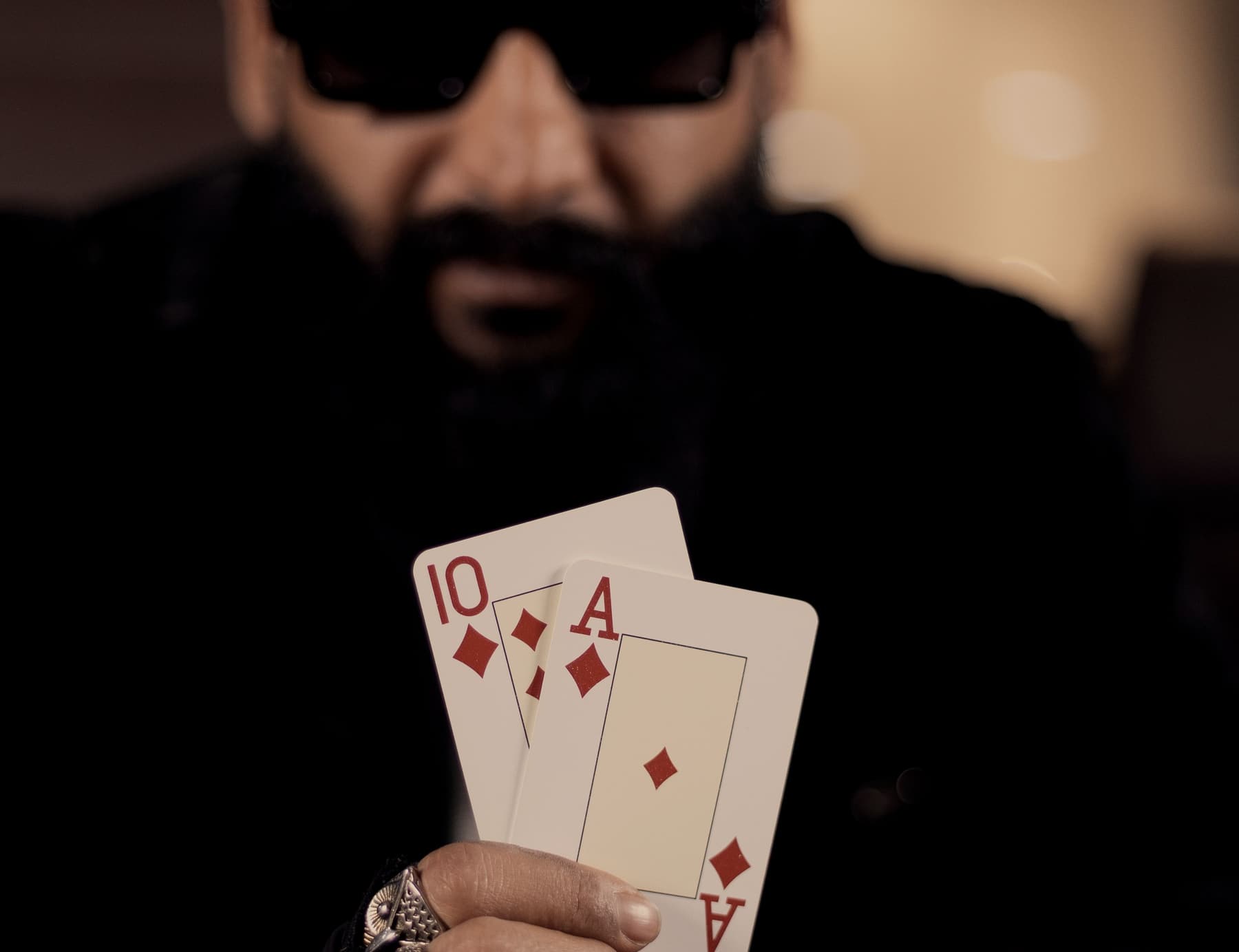
Most people learn poker the expensive way. They watch a few videos, memorise which hands beat which, and then sit down at a table where every other player has years of experience reading exactly this kind of newcomer. The cards are only half the game, and it’s the other half nobody explains properly.
This beginner poker guide covers both halves. You’ll learn the hand rankings, how a hand actually plays out from deal to showdown, the vocabulary you’ll hear at any table, and, most importantly, the small set of strategic habits that let a new player hold their own far sooner than they’d expect. Everything here applies whether you’re planning a home game with friends or your first session at a live poker club.
No prior knowledge assumed. Let’s start from zero.
What Makes Poker Different from Other Card Games
Blackjack is you against the house, and the house has a built-in edge you can never overcome. Poker is different in a way that changes everything: you play against other people, and the club or cardroom simply hosts the game. There is no house edge working against you, only the skill gap between you and the players around the table.
That’s why poker rewards study in a way roulette never will. Over a single evening, luck dominates. Anyone can win one night. But across hundreds of sessions, the player who makes better decisions wins the money. Professional players don’t exist in blackjack for a reason; they exist in poker because skill genuinely decides outcomes over time.
The second thing that makes poker unique is incomplete information. In chess, both players see the whole board. In poker, you see your own cards and must infer everyone else’s from their betting, timing, and behaviour. Every bet is a piece of a puzzle. Learning to assemble that puzzle, while giving away as little as possible about your own hand, is the lifelong craft of the game.
Poker Hand Rankings: The Foundation of Everything
Before anything else, you need the hand rankings cold: not “mostly memorised,” but instant. Hesitating over whether a flush beats a straight while a pot is building is how beginners make panicked mistakes.
From strongest to weakest:
| Rank | Hand | Example |
|---|---|---|
| 1 | Royal Flush | A♠ K♠ Q♠ J♠ 10♠ |
| 2 | Straight Flush | 8♥ 7♥ 6♥ 5♥ 4♥ |
| 3 | Four of a Kind | Q♦ Q♣ Q♥ Q♠ 9♦ |
| 4 | Full House | J♣ J♦ J♥ 4♠ 4♦ |
| 5 | Flush | A♣ 10♣ 7♣ 5♣ 2♣ |
| 6 | Straight | 9♠ 8♦ 7♣ 6♥ 5♠ |
| 7 | Three of a Kind | 7♥ 7♦ 7♠ K♣ 2♦ |
| 8 | Two Pair | A♦ A♣ 8♥ 8♠ 3♣ |
| 9 | One Pair | 10♠ 10♥ A♦ 6♣ 4♥ |
| 10 | High Card | A♥ J♦ 8♣ 5♠ 2♥ |
A few details trip up almost every new player:
- A flush beats a straight. Five cards of the same suit outrank five in sequence. This is the single most common ranking mix-up at beginner tables.
- The ace plays high or low in a straight. A-2-3-4-5 (the “wheel”) is the lowest straight; 10-J-Q-K-A is the highest. An ace can’t wrap around (Q-K-A-2-3 is nothing).
- Kickers decide ties. If two players both hold a pair of kings, the highest remaining card, the kicker, breaks the tie. Kickers decide far more pots than beginners realise, which is why hands like K-3 offsuit are traps: even when you pair your king, you often lose to a king with a better kicker.
Drill these until they’re reflexive. Deal yourself five cards at home and name the hand instantly. It takes an evening or two, and it’s the best time investment a new player can make.
How a Hand of Poker Actually Plays Out
Texas Hold’em is the game you’ll find at virtually every club and casino, so that’s what we’ll walk through here. (For the complete rules including blinds, button movement, and showdown order, see our full breakdown of Texas Hold’em rules.)
The Setup
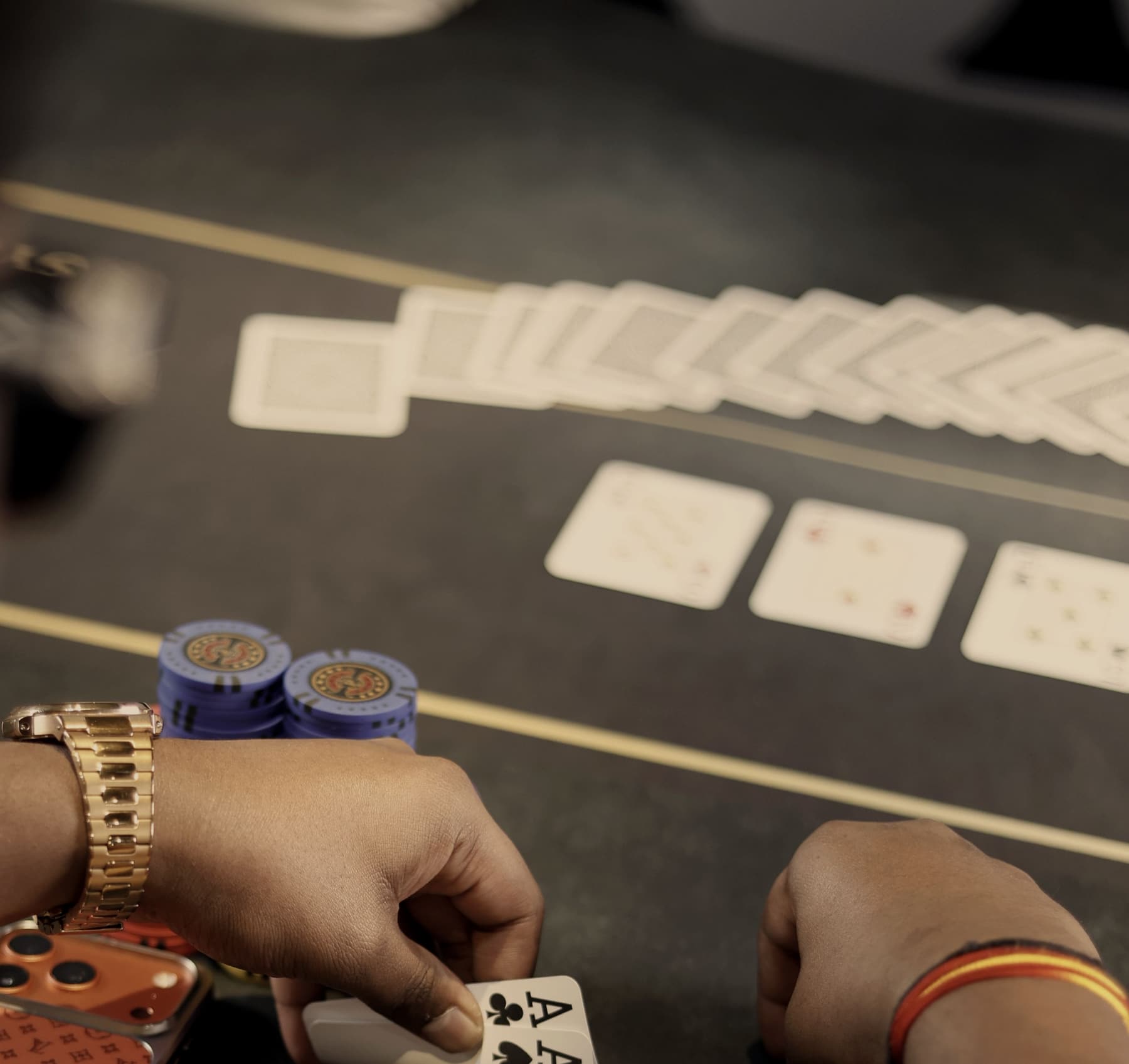
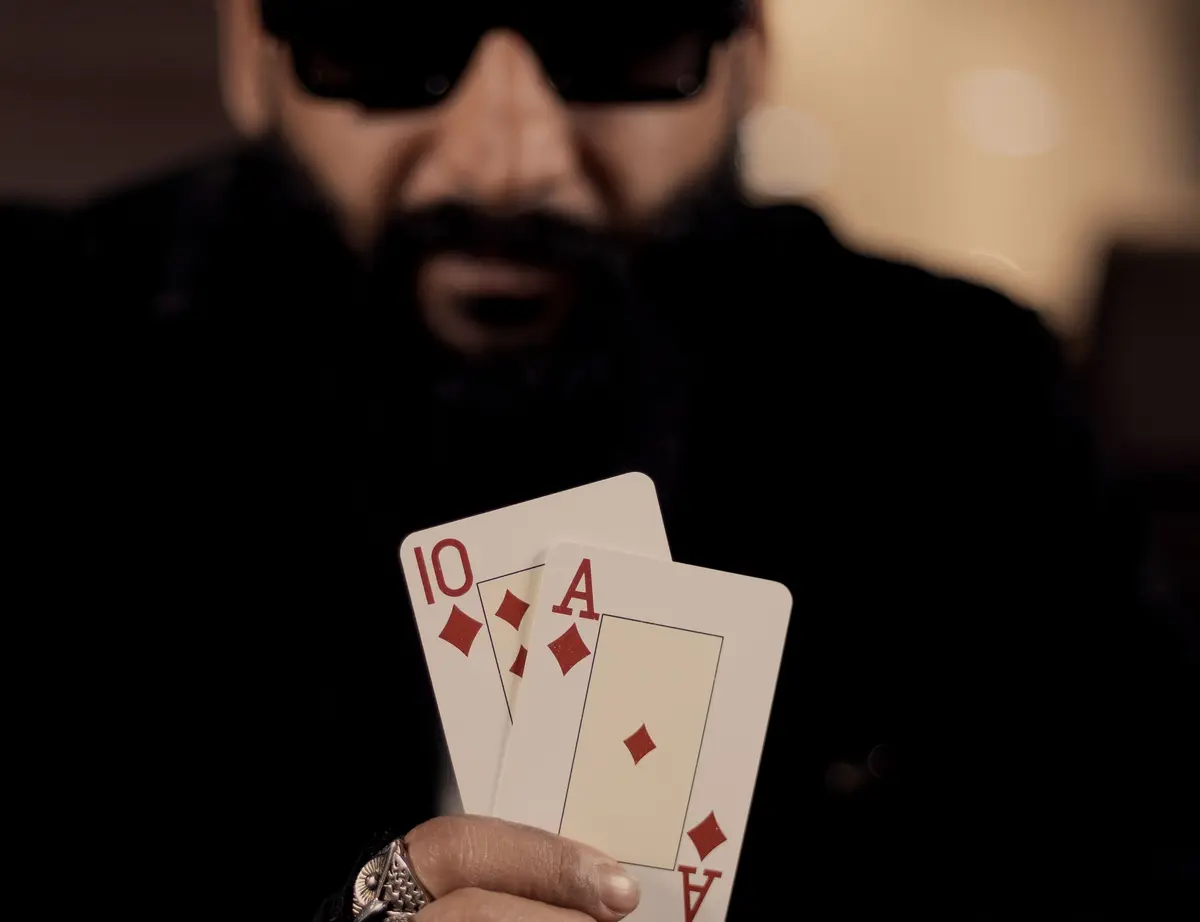
Each player receives two private cards, called hole cards. Over the course of the hand, five community cards are dealt face up in the middle. Your final hand is the best five-card combination you can make from your two cards plus the five on the board, in any combination.
Two players post forced bets called the small blind and big blind before cards are dealt. The blinds rotate clockwise each hand, so everyone pays their share. Blinds exist to create something worth fighting for; without them, everyone could simply wait for aces.
The Four Betting Rounds
Pre-flop. You look at your two hole cards and decide: fold, call the big blind, or raise. This is the decision you’ll make more than any other in poker, and playing it well matters more than anything else in this guide.
The flop. Three community cards are dealt face up. Another betting round follows. This is where your hand starts to take real shape. Suppose you hold A♥ K♥ and the flop comes K♦ 9♥ 4♣. You now have top pair with the best possible kicker, a strong hand worth betting.
The turn. A fourth community card. Bets are typically larger now, and the pots more meaningful.
The river. The fifth and final card, followed by the last betting round. If two or more players remain after the final bets, hands are revealed at showdown and the best five-card hand takes the pot.
At any point, a bet you’re unwilling to match means you fold and surrender the pot. Folding is not losing; it’s the most profitable move in poker used at the right moments. Strong players fold most of the hands they’re dealt.
The Language of the Table: Essential Poker Terms
You don’t need the whole dictionary on day one, but these terms come up in nearly every session:
- Check: passing the action without betting, when no one has bet before you.
- Call: matching the current bet.
- Raise: increasing the bet. A “three-bet” is a re-raise over an initial raise.
- Position: where you sit relative to the dealer button. Acting later is a genuine advantage because you see what everyone else does first.
- Pot odds: the ratio between the current pot and what it costs to call. If the pot is 100 and it costs you 20 to call, you’re getting 5-to-1, the mathematical backbone of calling decisions.
- Draw: a hand that isn’t strong yet but could become strong, like four cards to a flush.
- Tilt: playing emotionally after a bad result. Recognising your own tilt is a skill in itself.
- The nuts: the best possible hand at that moment.
One habit worth building early: when a dealer or another player uses a term you don’t know, ask. In a well-run cardroom nobody minds, and dealers at professional venues answer these questions dozens of times a week. Part of what makes learning at a club like Poker Syndicate easier than learning at a kitchen table is exactly that: experienced dealers who keep the game moving and are happy to clarify rules on the spot, so you learn correctly the first time.
Your First Strategy: Tight and Aggressive
Here is the honest truth about beginner strategy: you don’t need bluffing, soul reads, or advanced mathematics to be competitive in your first months. You need three habits.
Play Fewer Hands Than Feels Natural
New players play too many hands, usually 40–50% of what they’re dealt, because folding feels passive and everyone comes to the table wanting to play. Winning players at low stakes typically play around 20% of their hands. That means folding hands like Q-8, J-5, and K-4 without a second thought, even when it’s boring.
Why does this matter so much? Because weak starting hands create expensive second-best situations. Q-8 that flops a pair of queens looks great and loses a big pot to Q-J. The problem isn’t the hands you fold; it’s the hands you almost fold, then play, then can’t let go of.
A simple starting range: play pairs, big aces (A-Q, A-K), strong broadway cards (K-Q, Q-J suited), and suited connectors like 9♠ 8♠ in late position. Fold nearly everything else. You’ll refine this over time, but this alone puts you ahead of most beginners.
When You Play, Play Aggressively
If a hand is worth playing, it’s usually worth raising. Calling (“limping”) lets opponents see cheap flops against you and gives you only one way to win: showing down the best hand. Raising adds a second: everyone folds. Aggression also builds pots when you’re strong and forces opponents into hard decisions when they’re not.
Respect Position
The dealer button is the best seat in poker because you act last after the flop, with maximum information. Play more hands from late position and fewer from early position. If that’s the only positional adjustment you make in your first year, it’s still worth real money.
The Mistakes That Cost New Players the Most
Every beginner makes roughly the same errors, and knowing them in advance is half the cure. The big ones: overvaluing any pair, calling too often “to see what happens,” chasing draws without the right pot odds, and playing sessions while frustrated. We’ve written a dedicated article on the most common poker mistakes beginners make, with hand examples for each; it’s the natural next read after this guide.
The overarching theme is discipline. Poker punishes impatience quietly and relentlessly. The player who can fold for an hour and then play a big pot well beats the player who needs constant action, every time, over time.
Where Should You Learn: Online or Live?
Online poker offers volume; you can play hundreds of hands an hour. But live poker teaches things software never can: reading real opponents, controlling your own reactions, handling the rhythm and etiquette of a real table. Live games at lower stakes also tend to be softer, meaning more forgiving while you learn.
There’s also a social dimension that matters more than people admit. Learning alongside other players, talking through hands after a session and watching how stronger players handle spots, accelerates improvement dramatically. That community element is a core part of what a good poker club provides. At Poker Syndicate, beginners regularly sit in games with more experienced members who remember learning themselves, in an environment built around fair play and a genuinely welcoming table culture. It’s a very different first experience from an anonymous casino floor.
The honest answer is that the two formats sharpen different skills, and the best players use both.
Managing Your Money from Day One
One final foundation before your first session: never sit down with money you can’t comfortably lose, and decide your buy-in before you arrive, not at the table. Poker involves variance; even correct decisions lose sometimes, and your bankroll is the shock absorber that lets you keep making good decisions through the swings.
As a rule of thumb, your buy-in for a single cash game session should be a small fraction of your total poker funds. We cover the full framework (how much you need for your stakes, when to move up, and when to move down) in our guide to poker bankroll management. Read it before you play for meaningful money. It’s the least glamorous skill in poker and the one that keeps players in the game long enough to get good.
Responsible bankroll habits are also the mark of a healthy poker culture. Any venue worth your time treats responsible gaming as a standard, not a slogan, and it’s something we take seriously at Poker Syndicate.
Conclusion
Poker looks complicated from the outside, but the path in is simpler than it appears: learn the rankings, understand the flow of a hand, play tight and aggressive, respect position, and manage your money like an adult. Do those five things and you’ll be ahead of most players who’ve been “playing for years” without ever studying.
What no article can give you is the feel of a real table: the rhythm of the action, the discipline of folding, the small thrill of a well-played pot. That only comes from playing.
Ready to deal yourself in? There’s no better place to take your first steps than a table with professional dealers, fair games, and players who remember being new themselves. Visit Poker Syndicate and experience what premium live poker feels like from your very first hand, and become part of a community that values skill, strategy, and great games.
Frequently asked questions
Both, on different timescales. Luck decides individual hands and sessions; skill decides results over months and years. This is why the same names reach tournament final tables repeatedly, something impossible in a pure luck game.
You can learn the rules in an afternoon and play a competent tight-aggressive game within a few weeks of regular play. Genuine proficiency in hand reading, bet sizing, and emotional control develops over months of playing and reviewing your sessions.
No-Limit Texas Hold’em. It has the simplest core rules, the most learning resources, and it’s the game running at nearly every club and casino, so what you learn is immediately usable.
For your first live cash session, plan two to three buy-ins for the smallest stake available, and treat it as tuition. Longer term, follow proper bankroll guidelines of around 20–30 buy-ins for the cash stakes you play regularly.
Rarely. At beginner-level games, opponents call too much for bluffs to work well. You’ll win more by betting your strong hands confidently and folding your weak ones. Bluffing becomes valuable later, once you can read situations and opponents.
Less than you’d expect at the right venue. Tell the dealer it’s your first time playing live, and they’ll guide you through the mechanics, and at a well-run club the table culture is friendly. Nerves fade within an orbit or two.
Skilled players beat their games consistently, but treat profit as a long-term outcome of studying and playing well, not an expectation for your first months. Play first for the challenge and enjoyment; the results follow the work.